Sunday, 21 February 2016

Home That Moves with the Sun

side


Adding solar panels to your roof is great, but they can't harvest the sun's energy at all times of the day. Or can they? Casas em Movimento (which translates to Moving Houses), solve this problem since they are designed to move with the sun, much like the sunflower does. The home was developed in collaboration with a team of architecture faculty members at the University of Porto in Portugal.


The technology that powers the home allows for the rotation of the main volume of the home and the tilting of the roofs, which maximizes the amount of harvested solar energy. This tech was developed specially for this project. The homes themselves are basically a metal structure that is fitted with mechanical articulations, which allows it to rotate 180 degrees. The movement of the house is set to automatically follow the movement of the sun, so it takes from 9-12 hours for the house to turn. The residents can also control this manually, and a full turn of the home can be achieved in just 12 minutes. The roofs of the homes can pivot by up to 60 degrees. This can be used to angled the rooftop mounted solar panels to maximize solar exposure, as well as to provide shading for the windows in the summer.


cliff


According to the company, the ability to rotate the home and tilt the panels makes it possible for the homes to produce 25,000 kWh of electricity per year. They also claim that the energy required to power the movement of the house for a day is equal to six 60 W lights being lit for an hour.


Casas em Movimento need no concrete foundations so they can easily be built just about anywhere. They are also easy to transport and construct, with all the necessary cabling and plumbing routed through a static section inside the house.


The firm has built two prototypes of the home until now, and they are currently working to commercialize the technology. They have plans to complete a demonstration showroom by May 2016.


Tuesday, 16 February 2016

A Cool New Tiny Home From Escape

ext


The tiny house making firm Escape, has built quite a few very innovative houses, many of which we also covered on this blog. They've come a long way and their latest tiny home creation, called Vista, is jam packed with features and has a very well-designed layout. It's also cheaper than previous models, and is available with all the necessary technology to take it off-the-grid.


int


The Vista home is built atop a trailer, measures 20 x 8.5 x 9.6 ft (6.1 x 2.6 x 2.9 m) and weighs 6,000 lb (2,720 kg) so it can be towed very easily. The home has a total floorspace of 160 sq ft (14.8 sq m), which is quite small. It does however feature plenty of windows that make it appear much larger than it is. The windows, and glass front door of the house are all made of energy-efficient Low-E glass. If greater privacy is desired, customers can also opt for obscured glass.


side


Cedar was used for the exterior cladding. The interior of the home features a living area, which doubles as a bedroom, while there is also a kitchen with ample counter space, and a bathroom, which are all located on one level. The home also offers lots of storage, such as under-bed storage, large cupboards, and several small nooks. The bathroom features a shower and a composting toilet.


storage


bathroom door


Aspen was used to clad the interior walls, while the flooring is oak laminate. Closed cell foam was used for insulation. Customers can also opt for the add-on of a rooftop-mounted PV array, battery storage, and inverter. Air-conditioning can also be installed if desired.


The basic version of the Vista costs $39,900, but that's just the introductory price, which will soon go up to $46,600.


Monday, 15 February 2016

Construction Data's Hot Projects - February 15, 2016

Listed below are Construction Data's Hot Commercial Construction Projects for the week of February 8 - 12, 2016. Our Hot Projects showcases three projects from each state in our coverage area and are a combination of the most viewed projects in Construction Data's Construction Lead Manager+ database by our customers. Alabama The Orthopedic Center Renovation [...]

Another Smart Renovation

trapdoor


From the point of view of sustainability, sometimes renovation makes more sense than tearing down and building from scratch. Especially in densely populated urban areas, where tearing a building down might not even be an option. And that's exactly what Anne Rolland, an architect from France, did. She turned an apartment in a townhouse dating back to the 1600s into a cozy modern dwelling. Her work is a great example of how easy and rewarding such a renovation can be.


Rolland turned the 258 square foot (24 sq m) apartment, which had been abandoned for over 70 years, into a modern studio. Due to the age of the building, the space had gone through a number of uses including being the stables and kitchen of a hotel. The apartment also has a hidden underground room, which is accessible via a ladder.


kitchen


The first step in the renovation was the removal of all the partitions in the apartment, and then installing a multipurpose furniture unit that separates the space in two, and has a number of other functions. This unit is similar to the ones we've seen before on this blog, and includes a desk, storage area, a closet as well as cupboards. It is made out of birch plywood, which did not require finishing.


unti


On one side of this separating unit is the bedroom, which is placed atop a raised platform. The bathroom is located next to it and is the only room in the main part of the apartment which can be closed off from the rest completely. On the other side of the partition is the kitchen and living area.


bed


bath


A very interesting part of this small apartment is the hidden underground room, which is accessible through a trapdoor. This room was once the so-called slurry pit, which was a space where the residents disposed of organic and animal waste. Since it was not put to this use for a very long time it is today quite sanitary to live in, and the owner will use the 107-square-foot (10 sq m) room as his music studio.


slurrypit


plans


Vote For Us In The 2016 Best Construction Blog Competition!


For the third consecutive year, Construction Data's Blog has been nominated for Construction Marketing Ideas' Best Construction Blog Competition. We finished third overall last year, and placed second the year before that. This year we hope to take home the top spot in both categories, but we need your help! The popular vote is a key component in [...]

New hardware to expand fast fiber-to-the-home

The cost of deploying fast fiber connections straight to homes could be dramatically reduced by new hardware. The innovative technology will help address the challenges of providing households with high bandwidths while futureproofing infrastructure against the exponentially growing demand for data.

Wednesday, 10 February 2016

Construction Firms Are Realizing The Benefits Of Virtual Reality


A recent survey by ARC Document Solutions on emerging technologies in the AEC industry revealed that 65.3% of respondents indicated virtual reality would be the next big technology trend. (The use of drones for surveying and project documentation was second at 61.9%.) The top two benefits of virtual reality use cited were easier visualization of [...]

Room-temperature lithium metal battery closer to reality

Rechargeable lithium metal batteries offer energy storage capabilities far superior to today's workhorse lithium-ion technology that powers our smartphones and laptops. But these batteries are not in common use today because, when recharged, they spontaneously grow treelike bumps called dendrites that can trigger short-circuiting and cause a potential safety hazard.

Tuesday, 9 February 2016

Case Study House Comparison

BUILD-LLC-CSH-2016-wire-frame

[All images + photos by BUILD LLC]


BUILD recently broke ground on the Case Study House 2016, which means that the design is complete and the building permit has been issued. We began our Case Study House experiment back in 2012 and CSH 2016 will establish our third project in the series. The mile-marker of ground-breaking establishes an excellent opportunity to compare the design of this project with the previous studies. The conclusions are not only surprising, but they're also beginning to inform the projects that we're designing for clients.


BUILD-LLC-CSH-2016-footings


Before we get into the comparison, it's worth noting that our Case Study Houses all focus on a similar set of circumstances. Because the project series aims to provide densification in a rapidly growing city, each tackles a compact urban lot (CSH 2016 is a tidy 4,355 square feet). Because these projects are built for ourselves, they exclude the embellishments and adhere to cost-effective budgets. As we are modernists, these projects also demonstrate materials and methods of the current time. For these reasons, BUILD's Case Study House series isn't necessarily applicable anywhere and everywhere. For instance, the parameters would change dramatically on larger suburban or rural lots where there's simply more buildable real estate within the setbacks of a typical lot.


BUILD-LLC-CSH-composite


One of the principles behind BUILD's Case Study House project is the exploration and implementation of new design ideas. Because we are the end users of the product, it allows us to experiment with concepts and details that may not yet be ready for clients or the market in general. While this was a design generator on CSH 2016, this is also where things get interesting. The more we tried to push and pull the design ideas further from CSH 2012 and CSH 2014 projects, the stronger previous architectural systems reaffirmed themselves. While there are a host of differences between the separate Case Study Houses, what is becoming more significant are their similarities. As architects and builders, it illustrates a couple of possibilities: either we have a lack of imagination or there are key design systems that simply work better than others given the conditions. We think it's the latter, and today's post does a deep dive into the similar design threads among all three houses. We've broken the study down into five systems for design and we're already starting to see these strategies influence the client-based projects here at BUILD.


GOING UP RATHER THAN OUT

By the time the setbacks and allowable lot coverage are taken into account for a compact urban lot, the buildable area could easily be limited to about 1,500 square feet. This is true for each of the BUILD Case Study Houses as the real estate we target is on the more cost-effective side. The 4,355 square foot CSH 2016 lot translates into 1,524 square feet of actual buildable area once the setbacks and lot coverage are deducted. Even if this buildable area were maximized, it's not a generous amount of area for a residence designed for a family. This limited footprint is offset by building higher, which allows for rationally stacked floors, it saves a bit of real estate for the yard, and allows the house to access better daylight and views. The height limit in Seattle is 30' for a flat roof structure which allows for a 3 story structure and a roof terrace if desired. Using this logic, the CSH 2016 keeps the footprint to 1,451 and the height to 27' from average grade.
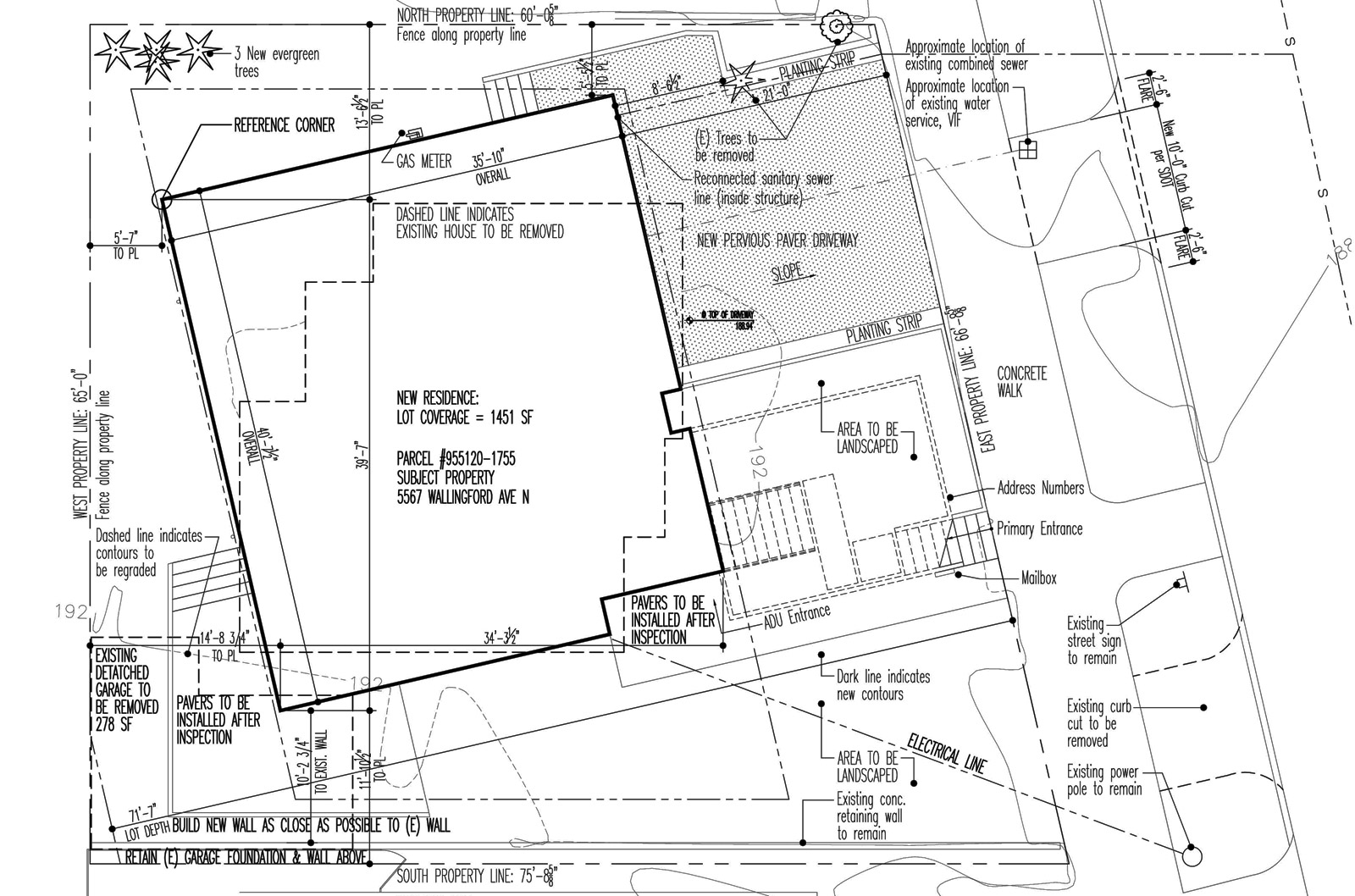

BUILD-LLC-CSH-2016-site-plan


THE INVERTED PLAN

Early in design schematics, we tested the traditional configuration of common areas on the ground floor with bedrooms on the upper level, but, once again, it lost out to the benefits of the inverted floor plan. This reversal of functions allows the common living areas, where you're spending the majority of time, to access maximum daylight and views. It also places the entertaining areas nearest the roof in the event that a rooftop terrace is desired. This arrangement pushes the bedroom spaces to the 2nd level and keeps the garage and, in this case, the accessory dwelling unit on the ground floor. The challenge with this configuration is to create an entry sequence that delivers people to the common areas without them feeling like they just climbed two flights of stairs. Similar to CSH 2014, the first flight of stairs is integrated into the landscaping of the front door approach. The exterior entry sequence focuses on layered terraces, paths, and focal points to take emphasis off the navigation of the stairs themselves. Once inside, it's only a straight run of stairs to the common areas. For compact urban lots requiring taller structures, the inverted floor plan continues to optimize the plan layout with the site and environmental factors.


BUILD-LLC-CSH-2016-Rendering


BOXY BUT BEAUTIFUL

The number one question from neighborhood spectators of the CSH 2016 has been: "Is the new house going to be boxy?" Whether people appreciate the honesty or are threatened by the modernism, our answer is always the same. It's not just going to look boxy, it is, truly, a box. A thoughtfully designed, well-articulated box. Simply put, boxes work best for interior spaces. Gable and hip roofs create awkward second floor spaces, necessitate dormers to offer less awkward second floor spaces, and exclude the possibility of rooftop terraces. Another important principle of the Case Study Houses is to create a model for housing that will last the entire 21st century, and creating practical, usable spaces is crucial to this goal. Boxes are better than triangles in this application and we arrive at this conclusion time and again in our Case Study Houses as well as the bulk of our work for clients.
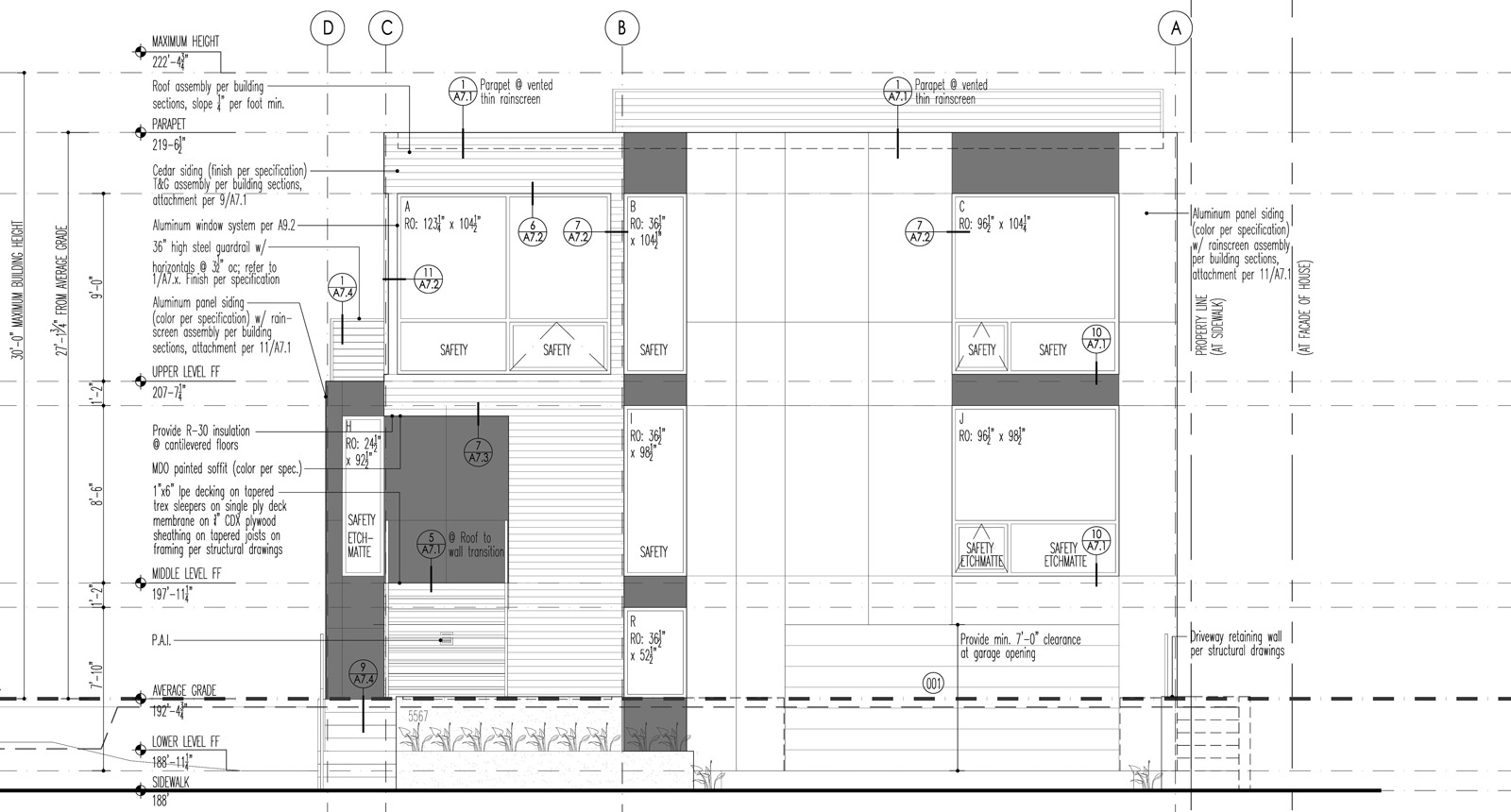

BUILD-LLC-CSH-2016-Elevation


JUDICIOUS USE OF MATERIALS

Every BUILD Case Study House has been designed with the mindset of durability and cost-effectiveness. This typically results in an envelope assembled of highly resistant but low maintenance materials like the standing seam metal used on CSH 2011 or the aluminum panels employed on CSH 2014. These keep the bulk of the structures water-tight, lessen the amount of maintenance required, and create a handsome exterior geometry. At the same time, we like to introduce warmer, more textured materials where they matter most. The approach and entry to the home are key areas to do so as the inhabitants and visitors are able to get up close to these materials and even touch them. The CSH 2016 uses white and silver aluminum rainscreen panels for the majority of the skin, while the entry area switches to a light-gray stained cedar to welcome visitors. This cedar requires more maintenance than the panels, but the work is confined to a very specific portion of the exterior.


BUILD-LLC-materials-01


The same strategy is apparent at the interior where walls are kept simple and clean, allowing the warmth and texture of the solid oak floor to become the personality of the space.


COMMON AREA QUADRANTS

Numerous plan layouts for the CSH 2016 were explored for the living room, kitchen, and dining room, however the most effective relationship was nearly identical to the CSH 2014. This configuration places the kitchen as the hinge point between the living and dining rooms with the dining room being nearest the south, with the kitchen behind. This allows the dining room to open up to a south facing terrace in both Case Study Houses while the kitchen has a direct relationship with both the dining room and living room. The remaining quadrant is dedicated to circulation space and a powder room. An additional home office volume is introduced into the CSH 2016. This office location allows a close and desirable proximity to the common areas, while maintaining a sightline to the front entry.


BUILD-LLC-CSH-upper-plans

[Left: CSH 2016, Right: CSH 2014]


Our hypothesis is that these five design strategies have emerged in the Case Study House series not by coincidence or convenience, but because they best address the design challenges of urban lots. Like any good scientific process, we'll continue to analyze the results of these explorations, refine our design ideas, and apply them to the next case study. Until then, stay tuned for some deep-dives into accessory dwelling units and the construction process of Case Study House 2016.


Cheers from Team BUILD


Saturday, 6 February 2016

Affordable Homes Built From Plastic Waste

home


The Mexican company EcoDomum has come up with a unique and very sustainable way of providing affordable housing for the less fortunate. They are manufacturing roofs and wall panels using discarded plastic, which they use to build homes with the help of a local housing programs. The end result is a large number of sustainable homes measuring about 430 sq ft that only cost around $280 each.


The panels made from plastic waste are about eight feet long and four feet wide, and one inch thick. According to the company they are very durable, as well as impermeable. They are also affordable, while the company can produce around 120 of them per day at their factory. In this way, they transform about 5.5 tons of discarded plastic into building materials per day. To construct a home, eight of these panels are used, which offsets around 2 tons of plastic waste. Each home can be constructed in a week.


panels


The process of building these homes starts with the collection of a wide range of plastic waste ranging from bottles to toys. Next, they sift through the plastic they collected to eliminate all the pieces that would emit harmful fumes when melted. Once this is done, they chop up the plastic using a special machine. These pieces are then put in an oven, which is heated up to more than 600 degrees Fahrenheit (350 degrees Celsius). It takes about half an hour to melt all the plastic, which is then passed through a hydraulic press that compresses and crystallizes the plastic into panels.


The company works directly with local trash collectors, paying them higher wages to ensure the constant supply of the plastic raw materials. In this way, the project has far reaching benefits since it works to boost the local economy as well as provide affordable housing. Not to mention the amount of harmful plastic that is recycled in this way.


To date, they have constructed over five hundred homes across Mexico, and already have contracts to build several hundred more. This year the company plans to expand it's facilities to cover the entire country.


Friday, 5 February 2016

Awesome Modern Renovation of a Small Apartment

fullapt


Air-BNB and similar sites are growing in popularity mainly because they are making travel cheaper and, in a lot of cases, more comfortable. In fact, many people are purchasing and renovating apartments simply for the purpose of renting them out to travellers. Such is also the case for the Position Collective design firm of Hungary. They have renovated a small apartment into an airy, light filled and quite functional living space.


The apartment measures just 323 square feet (30 square meters) and is located in Budapest, Hungary, which is fast becoming a very popular travel destination in Europe. Despite the small size, the apartment is very functional and modern, and should appeal to a variety of travelers' tastes, from casual tourists to digital nomads. In fact, I wouldn't mind living in it full time.


The apartment features a full-sized kitchen, with ample counter space, and a dining area at one end. One of the walls is covered in plywood paneling, while the rest is simply painted, white which increases the sense of spaciousness. The plywood part of the wall is a lot like a giant pegboard, and features lots of shelves, which are fully configurable and adjustable via clever inserts.


plywoodwall


The bedroom forms the centerpiece of the apartment and is comprised of an elevated platform also made of plywood. This area is accessible via stairs, and there is ample storage space built into the platforms under it. The bedroom contains what appears to be at least a queen sized bed, while there is a net curtain separating it from the kitchen. This is more for design purposes than any real privacy though.


shower


The bathroom is well sized too, and is equipped with a shower, toilet and sink. It also features a sandblasted glass window, which lets in plenty of light, but still offers privacy. There does not seem to be a lounging area in this apartment, but it does feature a balcony, which offers a great view of the city.


balcony


Wednesday, 3 February 2016

Net Zero Prefab That Can be Built in Just Three Days

back


Unity Homes has recently unveiled a prefab home, which is sustainable yet still made to last for at least as long as traditionally constructed homes. The home has a number of certifications, including LEED v4 Platinum, while it is also net-zero energy and can be constructed on site in three days or less. It is also fitted with the largest number of Cradle to Cradle (C2C) certified building products used in a residential project to date.


This so-called Zum model was built in collaboration with BUILDER magazine and the Cradle to Cradle Products Innovation Institute. The demo home pictured above, which was exhibited at the 2015 Greenbuild event, was made in the company's factory in New Hampshire in just five weeks. It measures 1,620-square-feet, and features two bedrooms and two bathrooms. On the Expo floor, the shell was built in a day and a half, and the rest, including the furnishings and additions took an extra two days.


dining


living


bed


The home is insulated using GreenFiber Cel-Pak cellulose insulation, which is made of 85% recycled paper fibers. To create the home's airtight envelope, which targets .6 ACH50, they used Huber Engineered Woods' ZIP Systems wall and roofing panels. The home is also fitted with fully operable triple-glazed unplasticized PVC (uPVC) Intus windows. The home is equipped with a Zehnder ComfoSystems CA 200 heat recovery and ventilation system, which works to provide an uninterrupted flow of fresh air into the home.


bath


bath2


Furthermore, the home is fitted with SunPower solar panels, which are the only solar panels to have received C2C certification. They are made completely out of non-hazardous materials and come with an energy meter and app. This is only one of many C2C materials and products used to build the home.


const


According to the company, they can build one of these homes in just 30 days yet they will be around for 300 years. They also use no fossil-fuels in the building process. Unity Homes wish to offer affordable as well as sustainable homes, so this prefab is priced at under $150 per square foot. This number could still drop to under $140 per square foot in 2016.


plan