Monday, 30 November 2015

Easy to Move Tiny Green Home

ext

Architects Luis Velasco Roldan and Ángel Hevia Antuña of Ecuador have designed a small, 538 sq ft (50 sq m) house called Nelson Homero ESPE Prototype II. The main aim for now is to perfect a prototype for a house, which is built using traditional methods and natural materials. The home can also be dismantled easily and moved elsewhere at need without a huge impact on the surrounding area. They will also be testing the prototype for energy efficiency in different climates.

The home is constructed atop of a series of concrete and steel columns, which work to elevate it off the ground a little. Volcanic pumice was used to fill the bottom slab, since this material provides great insulation and thermal inertia. To insulate the walls of the house they used palm rachis. The house itself is constructed out of natural materials and Eucalyptus and Ecuador Laurel wood, which is sourced locally.

pumice

At the site of the prototype, a tree was incorporated into the center of the home. The house also features a green roof and is made of a double asphalt layer, which provides a watertight shell. The roof also works to reduce the surface temperature of the house, meaning it keeps the interior temperatures comfortable in all seasons.

The house also comes with an automated power management system, which is connected to motorized shutters to provide shade in summer, and sunlight and solar heat gain in winter. The system is also able to maintain a constant internal temperature of 68-70° F (20-21° C), even when outdoor temperatures drop to 53° F (12° C).

The interior of the home features a kitchen, a dining/living area, a double bedroom, a study, and a fully equipped bathroom. There is a loft over the bedroom, which can be used as a second sleeping area. A large glass door opens from the living room, which makes the house appear more spacious and brings the inhabitants closer to nature.

int

kithcne

ng

bedroom

study

The prototype home will be dismantled and transported to different locations in order to test its energy efficiency in different climates. Once the prototype is perfected, the home will presumably be available for purchase.

plan

Friday, 27 November 2015

Clever Home Office in a Tiny Apartment

officeliving

These days, more and more people are working from home, and a lot of them are having trouble separating the work space from the living space. This can be especially challenging for those living in tiny apartments or houses. And that’s why this ingenious Tokyo apartment transformation is so awesome.

moving wall dining

Architect Yuko Shibata wanted to work from home mainly so as to avoid the high rents, yet she needed a space where she could meet with clients, given the nature of her work. She achieved her goal of creating an office in her small apartment through the use of cleverly placed moving walls.

moving wall1

work:living

Shibata calls her creation a “switch” design and she came up with it because it was pretty much the only option for her apartment. The building she lives in has a box-like reinforced concrete structure, with the walls being structural elements that can’t be taken down. Her work was inspired by the so-called “fusuma”, namely the historic Japanese sliding partitions used to sub-divide an existing space when needed.

officehshelves

She added to the original idea by adding a rolling wall to it, which can be used to hide or reveal a bookshelf behind it. When the wall is moved out, it creates a library and client meeting area, while the large table in this space can be used as a conference table and dining table. To create the office, she cut a hole in the wall which allows her to have a two-room workspace/library. The office space also has a built-in bookshelf, which when pushed back creates a cozy reading nook, additional storage space and more shelves.

dining

Perhaps the best part of her renovations is that they only cost about $7,000, and very little changing up of the original structure of the apartment had to be performed. It’s definitely a DIY sort of project and a great inspiration for anyone looking for ways to separate their home office from the living space in a small apartment.

Watch the video tour at Fair Companies.

Thursday, 26 November 2015

Tiny Aquaponics System

on bowl

More and more people are gravitating toward growing their own organic vegetables and fruits, and with various indoor systems designed for the purposed this is getting easier. However, aquaponic, hydroponic and other such setups require quite a bit of space, so they are not an option for a lot of city dwellers and those living small. But now, the Australian design firm Avooq has come up with a solution. They have designed a 3D printed aquaponics system, which is small enough even for tiny apartments and houses.

aqua1

The system they created is called Cascaqua, which is short for Cascading Aquaponics System. The entire system is not much bigger than a typical fish bowl, yet it is still a perfectly working closed loop ecologically balanced system, in which the plants and fish exist symbiotically, as they help produce organic food.

The design for the system can be downloaded for free from the company’s website and is currently in the patent-pending stage. The main materials needed to make your own Cascaqua system are basically a set of ABS plastic pieces. These can be 3D printed in about 8 hours. The pieces are then assembled on top of a regular fish bowl, while the system also requires a submersible pump and tube, which you must buy separately.

assempbly

plan

Due to it’s size, this system is more suitable to growing herbs and spices, then lettuce, tomatoes and cucumbers, though I suppose using a bigger tank and adapting the top pieces to it could give you a bigger garden. I guess cherry tomatoes, garlic and spring onions could still be grown in it though. Either way, it’s a unique little aquaponics system, which would make a great addition to any tiny home or apartment, even if it is just to give you a fresh supply of spices year-round.

Wednesday, 25 November 2015

Limited Number of Superhouses to Be Built

side

Magnus Ström, the owner of UK firm Ström Architects, has announced plans to design and build a limited number of superhouses. The idea is simple: construct luxury homes with all the modern amenities that feature sustainable technology, which allows them to operate completely independent of the grid. The houses are currently in the concept stage.

The Superhouse will offer a lifestyle not just a home, according to Ström, and the homes will feature quality of design and workmanship such as can be found in superyachts. Ström only plans to make 30 of these houses to retain exclusivity, while he plans to work closely with the buyer so the finished product adheres to their wishes completely.

The first concept house, numbered S 00/30, will soon be built on an island somewhere in the Mediterranean. It will be located in a quiet, private bay, which can only be accessed via a winding mountain road or by helicopter. The exact location has not been disclosed.

The base of the Superhouse will be made up of two timber volumes. The first of these will house the kitchen, a storage area and staff accommodation. The other one will contain a gym and spa. Sliding screens will be used to separate the kitchen from the dining room as needed, while these movable screens will also be in place to separate the gym and spa.

living

Over the wooden volumes there will be one long space, which will house the main living areas with a floating staircase leading to it from the ground floor. This area will house the master bedroom at one side, as well as four other, smaller bedrooms, and a large gallery area.

bath

bedroom

The house will also feature a large deck, with an overhang to provide solar shading, while the yard also contains a 164 ft (50 m) pool. There will also be garage with space for eight cars and a large basement with a wine cellar, a home theatre and an indoor golf driving range.

pool

Despite all these luxurious bells and whistles, the home will function completely off-the-grid. The energy needed for heating and cooling will be kept very low with the help of thorough insulation, while the home will also be fitted with a heat recovery ventilation system. There will be a photovoltaic array on the roof capable of generating as much energy as is needed, while the surplus will be stored in several Tesla Powerwall Units and available for later use. There will also be an on-site mini-sewage treatment plant for handling waste.

It sounds like a Superhouse will be very expensive and also obviously only available to a select few individuals. Which really is a shame, since the world needs more such off-the-grid superstructures to be affordable and widely accessible.

Tuesday, 24 November 2015

Scalable Modernism

BUILD-LLC-Magnolia
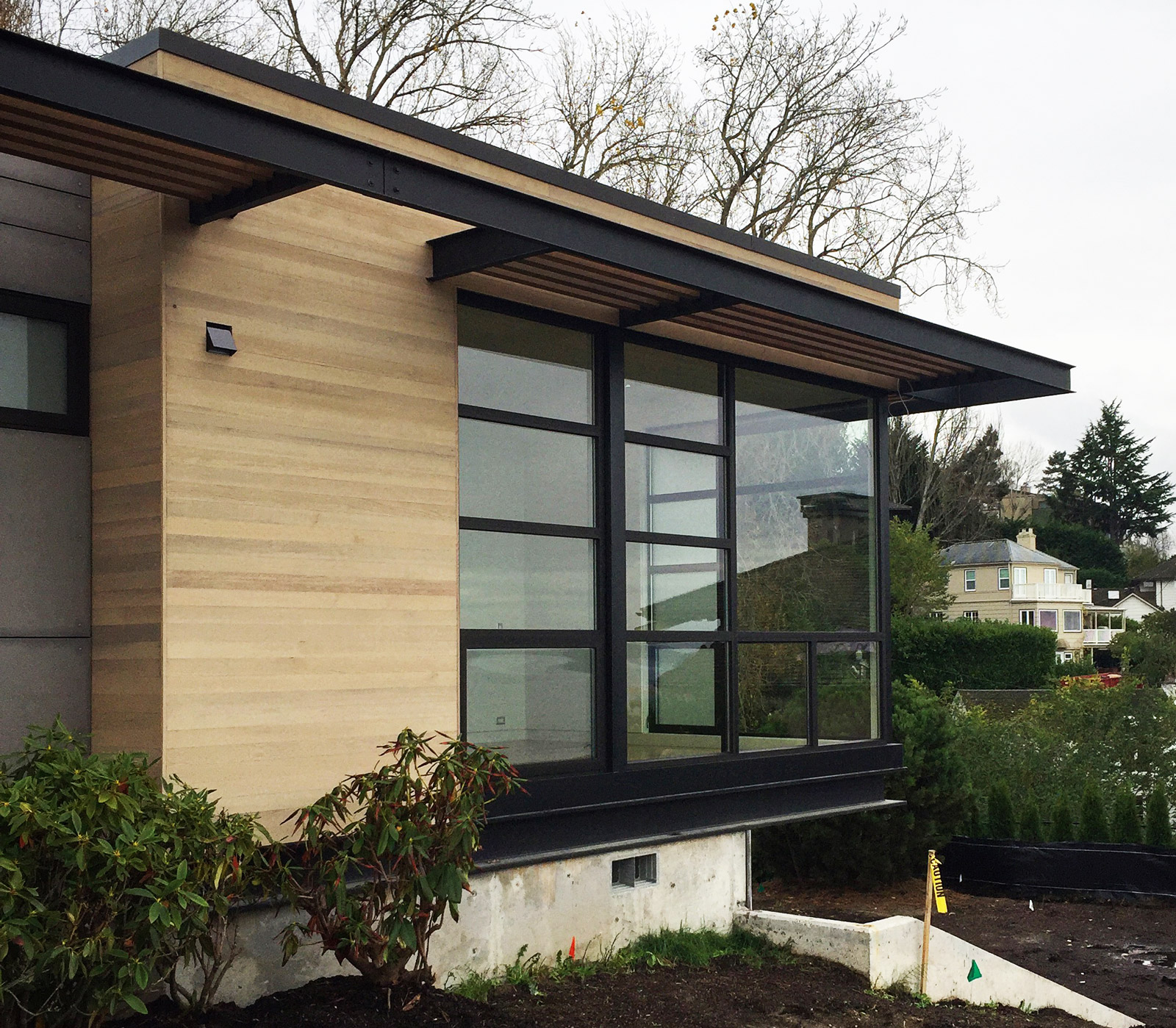
[Single Family Residence in Magnolia, photo by BUILD LLC]

The roster of projects currently in design at BUILD spans everything from large apartment buildings to custom single family residences, and everything in between. This bandwidth of projects allows us to apply our skills to living spaces of all scales and master housing as a typology. Along with this purpose, comes an invaluable test of modern design. All too often, sleek, inspiring modernism is thought to be the result of exclusive, custom residences commissioned by society’s elite. On the contrary, we’re firm believers that good modernism can apply to design at any scale — for renters, homeowners, and wealthy patrons alike.

It’s important to note that we’re not referring to a modernism of slick and trendy embellishments. The modernism that concerns us has both feet on the ground. It is a straightforward modernism for the usefulness of everyday life — we refer to it as sensible modernism. This brand of modernism is inspiring and forward-thinking while maintaining a pragmatism about it. We often say that sensible modernism is everything it needs to be and nothing more, and there’s no better way to filter down the possible design strategies than by applying them to a range of project scales.

If an architectural strategy is essential to the design of a tidy apartment as well as a spacious single-family residence, it’s usually the mark of sensible and timeless modernism. These strategies are limited, but when we discover them, they go straight into our bag of architectural tools. Decades of experience have taught us to nurture, protect, share, and even defend these strategies, and today’s post will examine five of the most important ones.

Generous Glazing
As achievable as this seems on a single-family residence, getting floor to ceiling windows through the design process of a multi-family development can be quite challenging. Big, beautiful, windows let in an abundance of natural light and offer more opportunities for natural ventilation. We believe these are basic life qualities that all people should have access to. Floor to ceiling windows also offer more transparency between the indoors and out, and encourage eyes on the street, making urban environments safer. We like to design window packages as generous as possible and include operable panels away from lines of sight to minimize interference with the light and views.

BUILD-LLC-Park-Modern-Night
[Park Modern, photo by BUILD LLC]

Interior Alignment
While lining-up walls, doors, windows, and other interior components seems like a no-brainer, a simple Google search for “floor plans” not only assaults the viewer with all scales of cluttered and convoluted design, but proves that the merits of clean lines are missed by homeowners and architects alike. The simple exercise of alignment creates a harmony within a space and, whether it’s consciously recognized or merely felt, design harmony has a significant influence on life harmony at all scales. We like to align the doors of opposing walls down a hallway and even mirror bedrooms as to provide harmony within the plan.
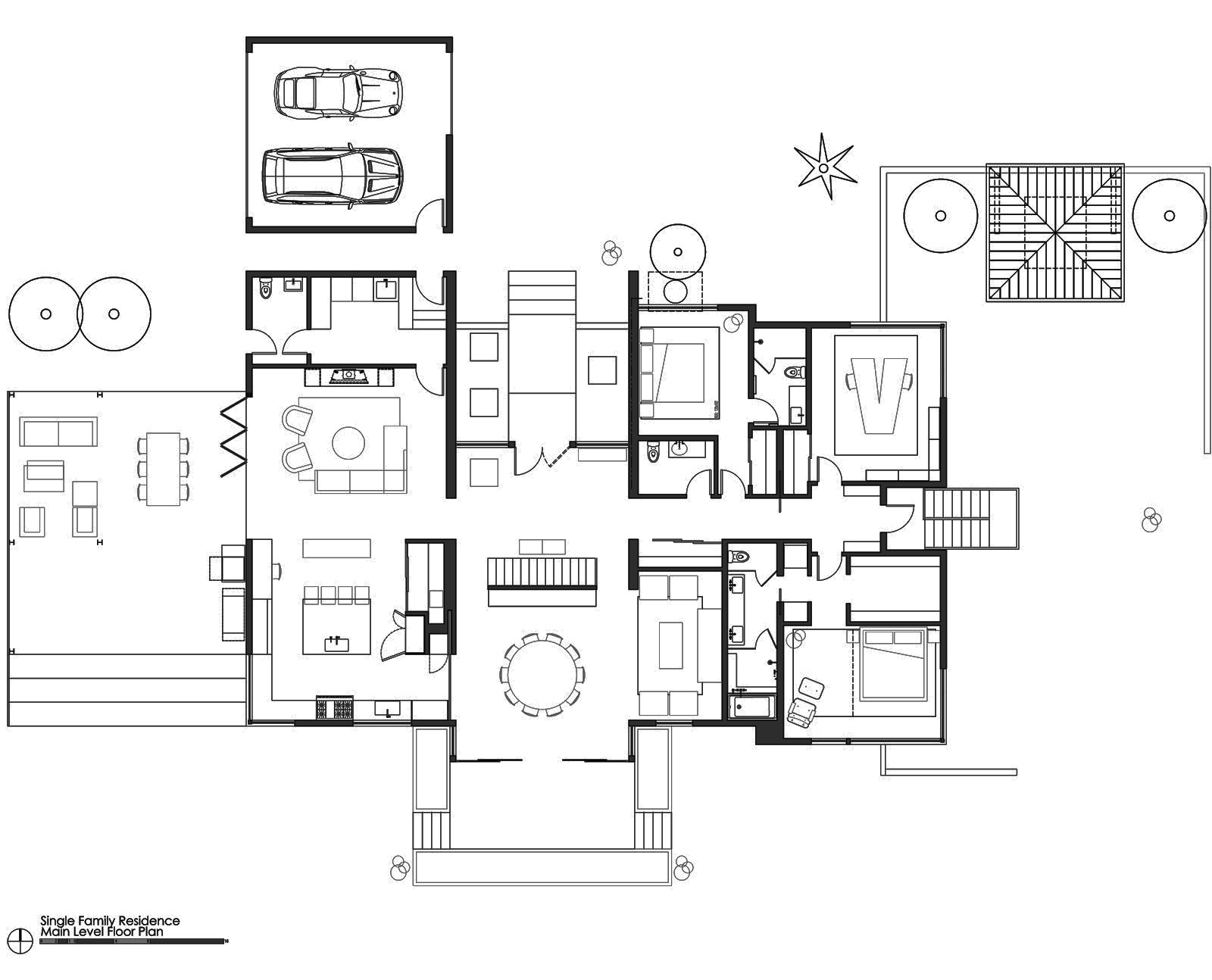
BUILD-LLC-Magnolia-Residence-Plan
[Single Family Residence in Magnolia, plan by BUILD LLC]

Sightlines and Focal Points
Intentionally designing hallways and corridors to include opportunities for art, views outside, or avoiding design dissonance has a tremendous effect on the experience of a living space. Under the best circumstances, we’ll terminate a hallway with floor to ceiling glass and a view to a significant landscape feature. When a window is not possible, we’ll designate space for a sculpture or wall hanging. If creating space for a significant focal point isn’t possible, doors, windows and other architectural features should at least be configured as to not conflict with the alignment of the view axis (e.g., you shouldn’t see half a doorway at the end of a hall). This is simply good planning at any scale.
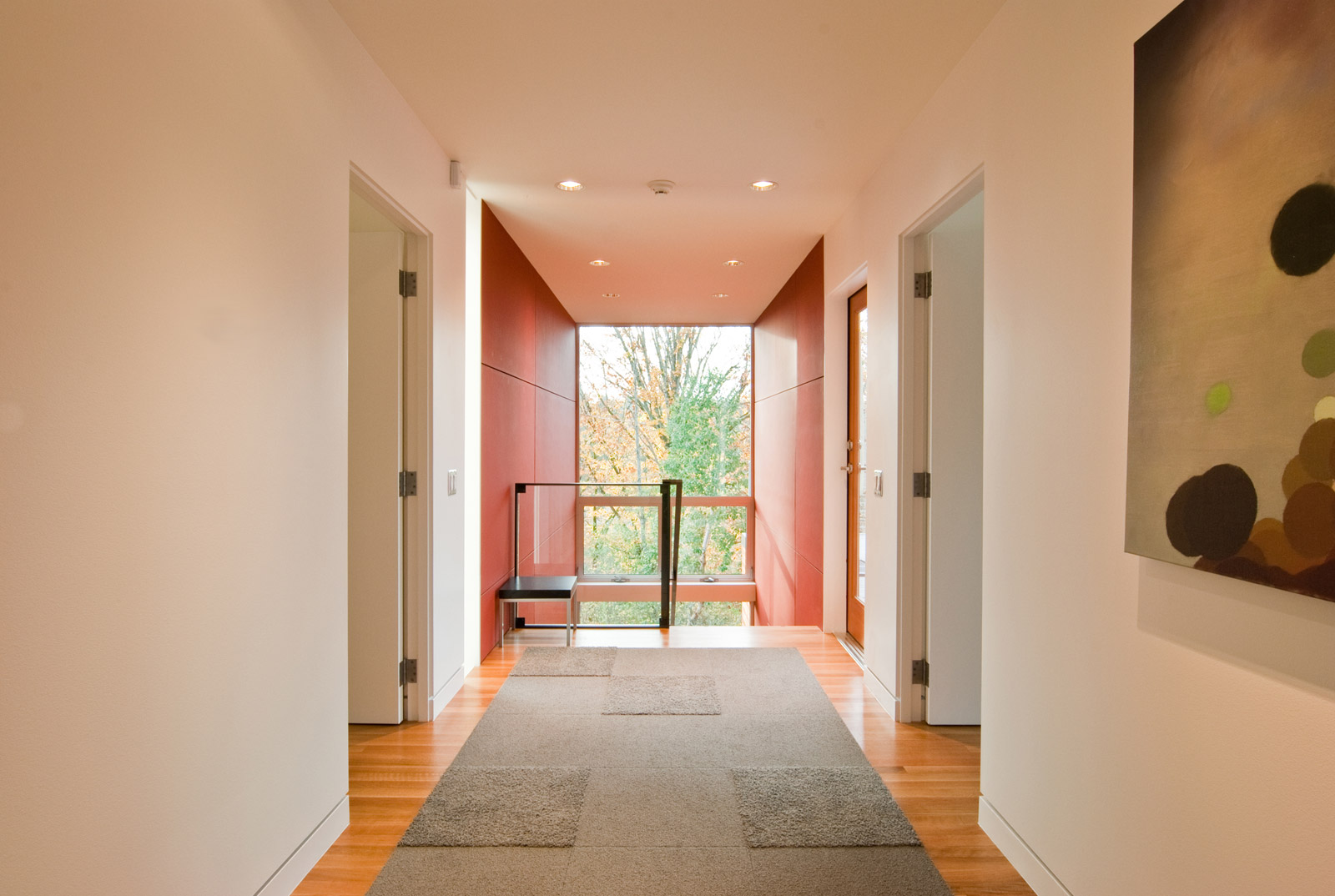
BUILD-LLC-Bellevue-02
[Single Family Residence in Bellevue, photo by BUILD LLC]

Keep It Orthogonal
Angles, especially the notorious Spec Builder 45° Angle Extravaganza are typically used to reconcile plans that haven’t been well conceived. Or used as an attempt to make spaces seem more dynamic in the vein of corner fireplaces and angled kitchen islands. Thoughtful, efficient design doesn’t rely on gratuitous angles; the wasted space muddies the layout and the finicky angles make detailing unnecessarily more difficult.

BUILD-LLC-Park-Modern-Plan
[Park Modern, plan by BUILD LLC]

Orderly Circulation
Circulation paths don’t always have to be straight lines and 90° angles, but circulation that seems to senselessly meander through a variety of interior living spaces only enforces the fact that it was not thought through. This type of aimless circulation path deteriorates the function of spaces and eats up precious square feet. We favor straight, dedicated lines of circulation, and when space is tight, the circulation can overlap with other functions in a manner that makes sense, such as a galley kitchen.

BUILD-LLC-First-Central-Station-Plan
[First Central Station, plan by BUILD LLC]

These five strategies of modern design can be applied to various scales of modernism, and the images above provide examples from projects both built and in design. Perhaps best of all, these strategies don’t necessarily cost more — their successful execution is typically a matter of planning and defending good design from the start. And whether these design strategies hard at work are recognized is beside the point. The strategies improve the quality of life and offer a healthy and harmonious backdrop for inhabitants to make the space their own.

Cheers from Team BUILD

New Battery That’s Cheaper and Lasts Longer

emptybatterynomore

Batteries are not what they could be yet, and a lot of research goes into perfecting them. A team of researchers at the University of Waterloo, Canada have been focusing on perfecting the lithium-ion battery, mainly by looking at the negative anode of these batteries, which are typically made from graphite.

According to the team, graphite has been used to create the negative electrodes in lithium-ion batteries, for a long time, but with the overall improvements in batteries, this material is becoming obsolete in terms of the limited amount of energy that it can store. The team has found a way to effectively replace this material with silicon.

When graphite is used, the maximum theoretical capacity of the battery is 370 mAh/g (milliamp hours per gram), while by using silicon the theoretical capacity jumps to 4,200 mAh/g. Silicon is also a much cheaper material. However, before it can be used, a way to prevent the silicon cracking had to be found. This cracking occurs when it interacts with the lithium inside the cell during the charge cycle, which causes the silicone to expand and contracts by more than 300 percent, and it is the cause of battery failure.

To combat this shortcoming, the team has developed a flash heat treatment for the silicon electrodes, which gives them a more robust nanostructure. Because of this structure, the contact between the lithium and the electrode has been lessened, which eliminates most of the expansion and contraction.

The new battery they designed has a capacity of than 1,000 mAh/g (or over 2,275 cycles), while the team is also sure that it will have a 40 to 60 percent increase in energy density over normal lithium-ion batteries. If these batteries would be used in an electric car, for example, it could go 300 miles on a single charge, while it would also be lighter, since the new batteries are lighter. The team is hopeful that the new batteries will be available commercially as early as next year.

Manipulating transistors at terahertz frequencies

An interdisciplinary team of researchers has found a way of accessing the interior of transistors. The researchers have manipulated the electron gas contained within by applying resonators to generate rhythmic oscillation in the terahertz range inside.

First Building to Receive the Passive House Premium Certification

houseofenergy

The Passive House certification is hard to get, and this is especially true for the Passive House Premium certification. The latter is a new level of certification and was introduced in early 2015. It was created in order to account for the transition of building energy sources from fossil sources to renewable energy. And the so-called House of Energy, a building in Kaufbeuren, Germany, has recently become the first structure to receive this prestigious certification, which certainly makes it one of the most sustainable buildings in the world.

The House of Energy has a heating demand of only 0.7 kWh per sq ft (8 kWh per sq m) per year, which is impressive for a building that measures 9,688 sq ft (900 sq m). This is in part achieved by a rooftop mounted PV solar array, which measures a whopping 2,691 sq ft (250 sq m).

The superb energy efficiency of this building was also achieved by installing triple-glazed windows throughout. The house also has a very high level of thermal protection and envelope airtightness, while there are also virtually no thermal bridges. The house also has a very efficient ventilation and heat recovery system, and is fitted with a ground-source heat pump, which provides both heating and hot water. All the surplus energy that is generated is fed back into the grid.

The House of Energy only requires 2 kWh per sq ft (21 kWh per sq m) of renewable primary energy per year. On the whole, constructing this house, as well as ensuring it’s day-to-day operation took advantage of all the well-known sustainable technologies and building methods, yet they are employed to such a high degree that the building merits this highest level of recognition.